Chasing the Sun
DFIs are missing Africa's solar-powered energy transition. Here's what they should do about it.
My uncle Christopher, who lives in Dallas, recently built a solar system in Oyani, the village in western Kenya where our family is from. A contractor in Nairobi did the work over WhatsApp, from quoting to payment to monitoring project progress through photographs of the panels going onto the roof.
As I wrote in a previous essay, our community spent more than a decade and about $170,000 building a 17-kilometer grid extension. The power line now serves as backup. The house runs entirely on its own generation, day and night.
Christopher’s installation isn’t an isolated occurrence. Ember, working with the African Tech Futures Lab, estimates that Africa will install 17 gigawatts of solar in 2026, up 45% from the year before, and the third consecutive record. That is roughly 100,000 panels a day, every day, for a year. Of the 26 gigawatts added between 2023 and 2025, Ember estimates that about 20 were distributed. This means three-quarters of the continent’s new generating capacity is in pieces small enough to fall below most reporting thresholds. Even Egypt, which has multiple ongoing utility-scale projects, is estimated at 43% distributed.
Development finance institutions (DFIs) are built to underwrite a small number of large assets with legible counterparties. As a result, the institutions that exist to finance African power were involved in almost none of this new solar capacity. Factory owners, shopkeepers, church committees, landlords, and households paid for the distributed buildout out of working capital, retained earnings, short-tenor local credit, mobile money, and cash. What DFIs do is hard, important work, and many do it well, but it is quickly becoming a sideshow compared with the wave of distributed solar generation driving energy access across the continent.
At the prices Christopher paid, 7 kilowatts of panels, a hybrid inverter, 15 kilowatt-hours of storage, and labor come to about $4,000. Scale that across a continent’s worth of rooftops and yards, and the distributed buildout represents tens of billions of dollars of privately financed generation.
Much of that money comes from individuals rather than institutions, and some of it comes from abroad. Africa received about $124 billion in remittances in 2025, roughly twice what it received in official development aid. Kenya took in a record $5.04 billion, its largest source of foreign exchange, and more than half of it came from the Americas, according to the Central Bank of Kenya. Christopher’s system is a small, typical piece of a large and growing flow of money that goes directly from individuals in places like Dallas to solar assets in places like Migori.
Falling costs are accelerating that flow. In December 2024, Christopher was quoted roughly $7,900 for 30 kilowatt-hours of storage, 62% of the total bill. About a year and a half later, he built his whole system for a little over $4,000, including 15 kilowatt-hours of storage for about $1,350. The quotes came from different vendors, but per kilowatt-hour, battery prices had fallen about 65%.
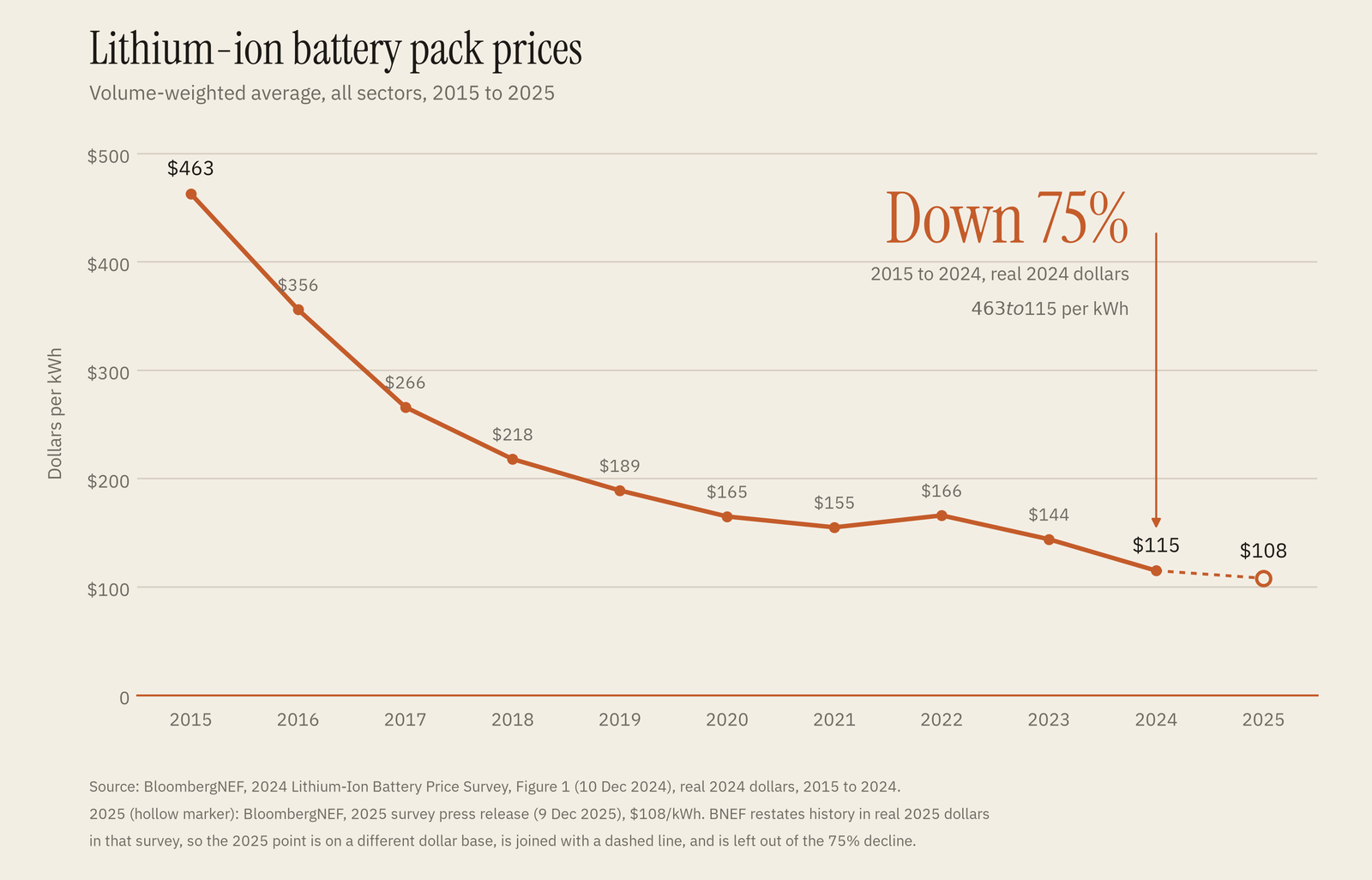
Source: BloombergNEF battery price survey
Cheaper storage also means that the 17 GW projected for 2026 is just the beginning. At 45% annual growth, the market roughly triples in three years, and a panel installed this year will still be generating in 2050. The market serving this buildout, made up of importers, distributors, and installers, is crowded, short of cash, and consolidating. Whoever lends to it now will shape which firms survive, and with them what gets installed on millions of roofs and to what standard.
Kenya has already seen what happens when buyers can’t tell good equipment from bad. In the 1990s, the country built one of the world’s largest unsubsidized markets for small solar home systems, with hundreds of small vendors selling roughly 150,000 systems to rural households. When researchers tested these panels in the field at the end of the decade, the better brands delivered 83% to 89% of their rated power. One widely sold brand delivered 55%, and four in ten of its units had failed outright. Its market share still rose, from about 20% in 1996 to more than a third by 2000, at the same price per watt as the panels that worked.
Households had no way to measure a panel’s output. The first sign of a bad one was the battery frequently running flat, so owners replaced the battery and the problem came back. Most vendors couldn’t measure output either; warranty claims were rare, and most owners didn’t know which brand they had bought. As a result, good vendors gained nothing from being good, the bad ones lost nothing from being bad, and buyers discounted everything on offer.
The same problem exists today on a much larger scale. The Kenya Bureau of Standards has flagged tampering with power labels on solar panels, and GOGLA, the off-grid solar industry association, reports that counterfeits selling at half price are making it hard for honest dealers to compete. Buyers are no better equipped to tell the difference than they were in 1999, and they are spending far more. Distributors can’t fix this on their own. Firms that buy better hardware, train their installers, and honor their warranties compete against those selling something that looks identical at purchase and fails in three years. Honest firms therefore carry costs they can’t recover, and the dishonest ones win sales while damaging the reputation of the whole industry.
DFIs shouldn’t try to finance Christopher’s rooftop system. Instead, they should focus on importers, distributors, and installation firms that look a lot like the borrowers they already know how to assess: big enough to have real balance sheets, few enough to vet, and growing faster than their cash allows.
Distributors can only grow as fast as they can buy stock and wait to be paid. DFIs can provide inventory loans, lending against what customers owe, and local-currency credit that lets customers pay over time. Lending can also fix the quality problem by attaching conditions, such as minimum hardware standards, installer training, and enforceable warranties. Firms that meet the bar get cheaper capital, lowering costs and enabling growth, and honest firms finally get paid for being honest.
Imposing standards solely through regulation runs into familiar problems: incumbents shape the rules, border checks invite delays and side payments, and small firms that do good work can’t afford compliance. Conditional lending offers a carrot for good behavior rather than a stick. Firms can keep selling cheap panels, but they go without the concessional financing their competitors have.
The distributed solar buildout will happen whether or not DFIs take part. What they can still influence is its quality. In the 1990s, it took Kenya’s solar market the better part of a decade to recover from the reputation of the panels that failed. Today’s market is vastly larger, the equipment going onto roofs will be there until 2050, and the firms that will supply it are being sorted now by whoever lends to them. DFIs can supply that capital and set its terms, or they can keep financing the sideshow while the main event is built without them.