Leapfrogging in Reverse
Why Nigerian factories and Virginia data centers are making the same decision from opposite ends of the world
For a century, the electric utility decided when you as the customer would be connected, how reliable your supply would be, and what you would pay. I spent six years working within, and often against, that arrangement, first as Director of Software Platforms and then as Chief of Utility Operations at PowerGen Renewable Energy, building and running distributed power systems across several African countries. I now spend my days analyzing PJM, the grid operator for Virginia and twelve other states, for Aurora Energy Research. That experience has given a unique vantage point from which to observe a shifting electric utility landscape: the industrial customer no longer has to wait, tolerate, or pay on the utility’s terms. Increasingly, it is the customer setting the terms, both in Africa and in the US.
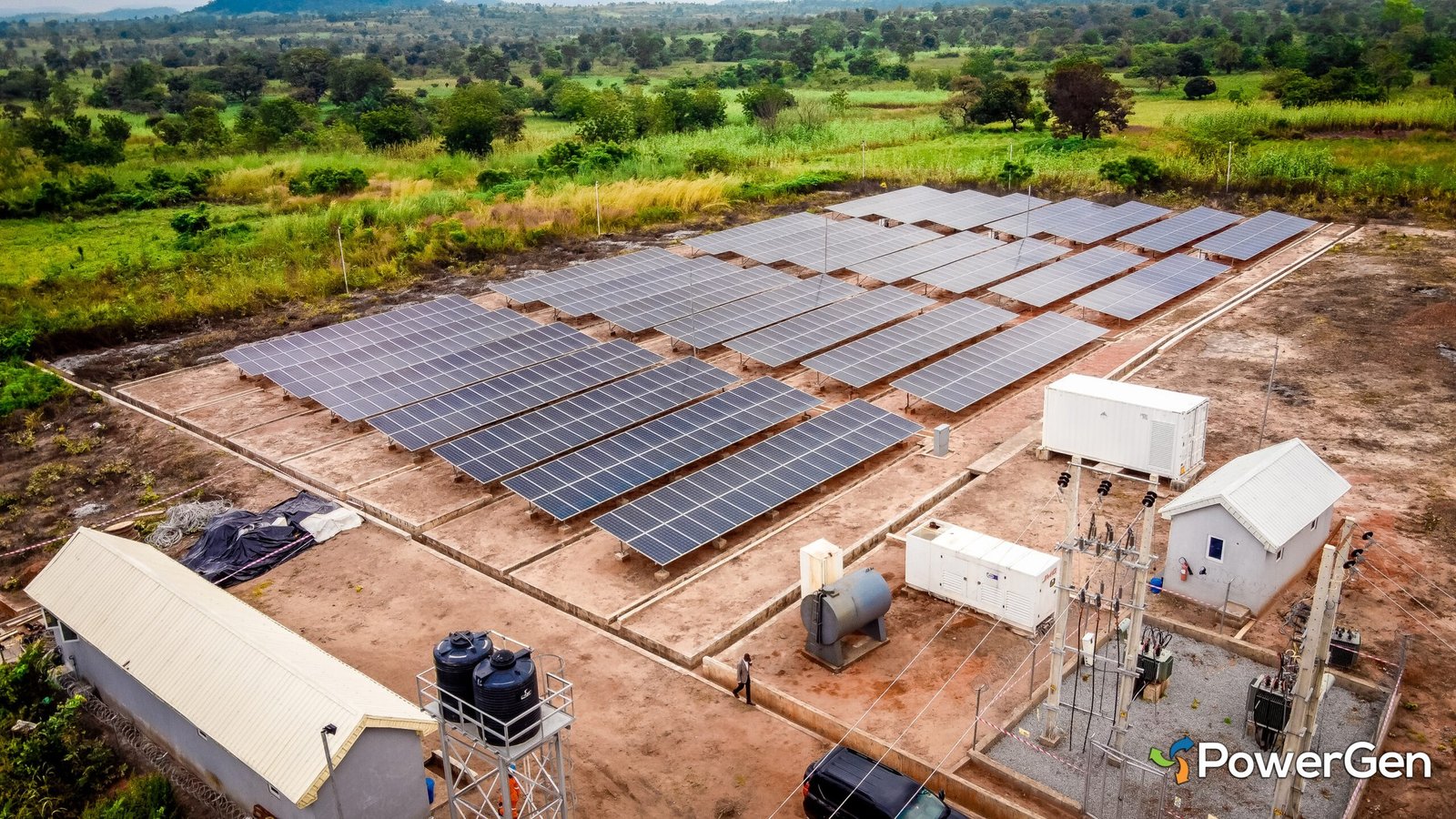
A PowerGen site. The developer builds, owns, and operates the plant; the customer pays for the electricity.
Noclink Ventures, a plastics manufacturer and recycler in Nigeria, is a typical example. In April 2026, PowerGen announced a 1.8 MWp solar plant for Noclink. The project was notable for its size, but the commercial structure was even more interesting. PowerGen built, owns, and operates the plant. Noclink pays for the electricity it uses and puts up no capital. During daylight hours the factory draws on solar; at night and during cloud cover it draws on the grid or, where the grid fails, on the diesel it already owns. Batteries will be added when they cost less than the diesel they displace, which on current cost curves is a matter of when rather than if.
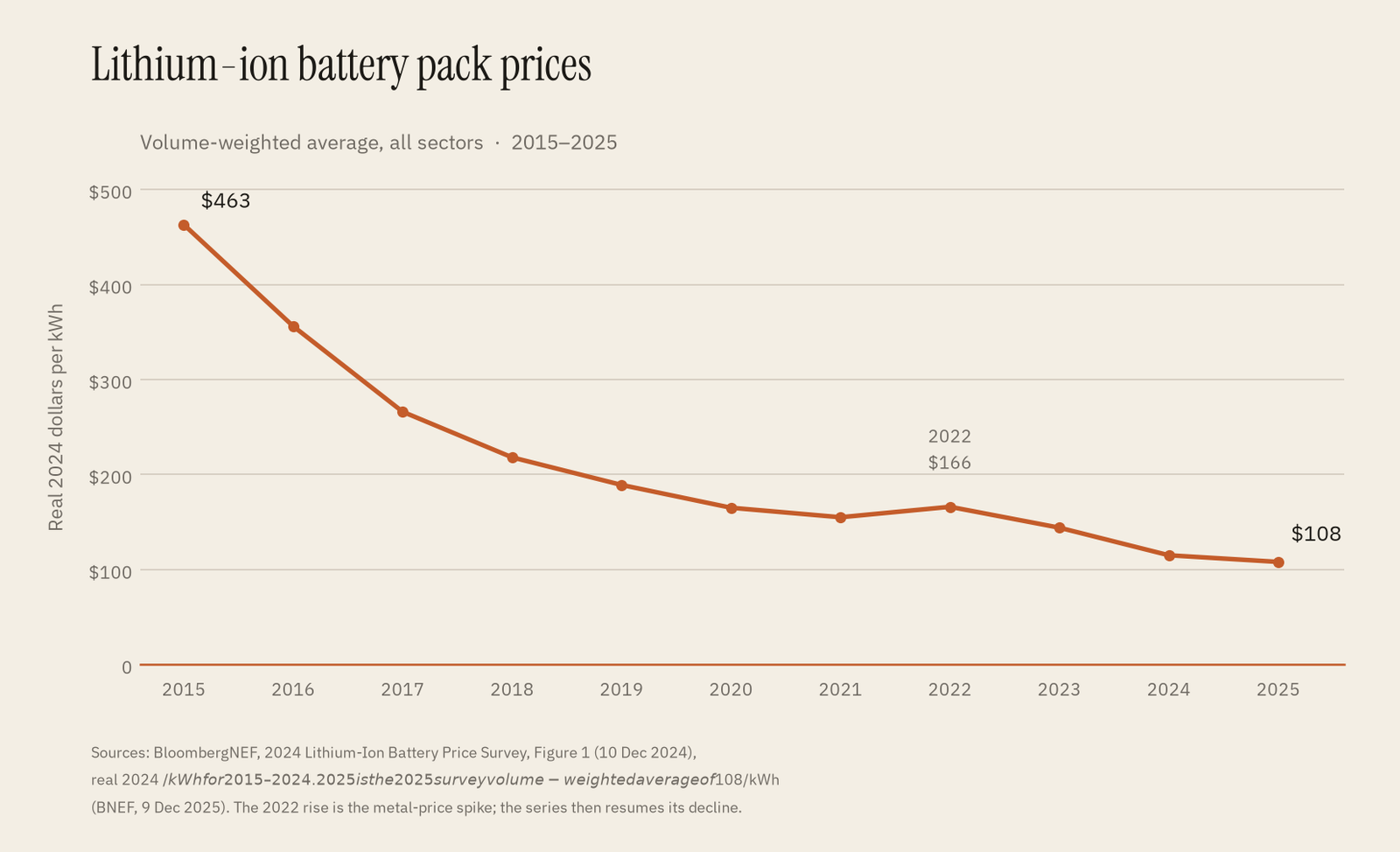
Volume-weighted average pack price, all sectors. 2015-2024 in real 2024 dollars from BloombergNEF’s 2024 Lithium-Ion Battery Price Survey, Figure 1. 2025 is the 9 December 2025 survey headline of $108/kWh.
Nigerian factories have run on self-generation for decades; the country’s businesses spend an estimated $13 billion a year on diesel because the national grid cannot be relied upon. What is new is that the self-generation is now cheaper than the grid rather than merely more dependable, and that a third party will finance it. As Aaron Cheng, PowerGen’s CEO, says in his 2023 letter, the most important question in African power is no longer which model wins, or off-grid versus on-grid, but who delivers. For Noclink, the answer was a solar developer, and the utility became a supplier of the residual.
The customer used to accept whatever reliability the utility could provide. Now the customer defines reliability and buys accordingly.
Seven thousand miles away, data centers are reaching the same conclusion from the opposite starting point. Ashburn, Virginia, sits on the most robust grids in the world. Dominion Energy, PJM, and the surrounding transmission network have delivered some of the cheapest, most reliable power in the United States for decades. And yet on 22 July 2026, when a fault hit a 230 kV line in northern Virginia, roughly 3.8 GW of data center load (equivalent to roughly 3 million U.S. households) transferred to on-site backup in two waves. It was the largest event of its kind in PJM’s history. PJM balanced the system in about nine minutes and reported no failure of the bulk grid. By the utility’s own definition, nothing went wrong.
Yet the data centers still left. Frequency and voltage moved during the fault, and the chips inside a modern AI facility cannot tolerate that movement, so the facilities did what they were built to do: they stopped trusting the grid and ran on their own generation until conditions settled. Their standard for reliability was tighter than the grid’s standard for itself.
The same logic governs how those facilities get built in the first place. A hyperscaler or a frontier lab that wants a gigawatt of capacity faces an interconnection queue that, until recently, ran four to five years from request to operation. FERC Order 2023 replaced the serial queue with cluster studies, and PJM’s first new cycle under the new rules accepted 715 projects totaling 201.5 GW in August 2026, roughly half of it gas and a third of it storage. That is real progress. It still means one to two years of study followed by construction. According to SemiAnalysis, a one-year delay on a 1 GW site postpones over $12 billion. With that much money on the line, energy costs, including the purchase of on-site gas turbines, reciprocating engines, and battery banks, stop being the deciding factor in construction decisions. Hyperscalers are price insensitive to almost anything that can get a data center online in 2027 as opposed to 2030.
As a result the American data center has begun to behave like a Nigerian factory, drawing on the grid where the grid is available and adequate, and building behind the meter supply where the grid is not. They are running Africa’s leapfrogging experiment in reverse. Much of Africa skipped building landlines and went straight to mobile, Virginia has built some of the best power lines in the world, and is building around them anyway.
However, this shift does not mean the grid is obsolete. Grid power is still cheaper per kilowatt-hour than almost anything a customer can build for itself once the wires exist. It provides the night supply that solar cannot and a power reserve that no single site can economically hold. Nobody in Nigeria or Virginia is proposing to disconnect. Noclink still buys grid power at night. The Ashburn facilities transferred back once the fault cleared. In PJM’s own Cycle 1 numbers, storage and gas dominate precisely because they complement the grid rather than replace it.
The difference is where the money is moving. For an industrial buyer, three gaps have opened between what the grid offers and what the buyer wants: a price gap where self-generation is cheaper, a time gap where the queue is slower than the business, and a control gap where the buyer’s tolerance is tighter than the utility’s. The new behind the meter solution closes whichever gap is binding. In Nigeria that is price and control. In Virginia it is time and control.
Utilities are right to be nervous about this, because the customers moving first are the ones they can least afford to lose. A plastics factory or a data center is a large, steady, creditworthy load, the kind that pays for the transformer and the substation that the household next door could never justify. When PowerGen sells Noclink its daytime kilowatt-hours, the Nigerian utility loses that revenue for good. When a hyperscaler builds behind the meter, Dominion loses the anchor customer that would have underwritten a decade of transmission upgrades.
The temptation is to fight, and utilities have a long record of fighting. When PURPA opened American industry to self-generation in 1978, utilities spent the better part of a decade in litigation and rate design trying to keep cogeneration out. They lost, and then they adapted, and the industrial customers who could self-generate stayed on the grid for backup and balance rather than leaving it. Load defection is older than rooftop solar. It arrives whenever a big customer finds a supplier that meets its requirements better than the incumbent, and it ends with the incumbent either becoming the partner or watching the customer become its competitor.
Well-structured deals can turn what initially seems like a threat into a growth opportunity for utilities. Private power developers can sell the daytime solar or the on-site gas. The utility then sells the residual, the night, and the balancing, and it owns the wires. Storage arrives where it wins on cost. In Africa this is a way for a cash-strapped utility to keep its most valuable customer without financing the plant. In Virginia it is a way to bring a gigawatt online in eighteen months instead of five years while the transmission catches up. Regulators can make this easy or hard, and the ones who make it hard should not be surprised when the customer builds around them. The utilities that resist this shift will spend the next decade in the queue watching its best customers leave. The one that chooses to see it as an opportunity will spend that decade selling reliability, owning the wires, and building the network fit for what comes next.