Power to the people (or how to bring electricity to 500 million Africans)
It's time to build!
This is part one of a three-part essay adapted from a position paper I wrote in 2018 while I was one of the directors at the Africa Minigrid Developers Association AMDA. It has been edited for readability and to account for developments over the past six years. Part two will be posted next week.
Two decades ago, mobile phones made traditional cable-bound telephone networks in Africa obsolete. I expect Distributed Energy Resource (DER) technologies to do something similar to conventional electrification approaches based on hub-and-spoke main-grid extension.
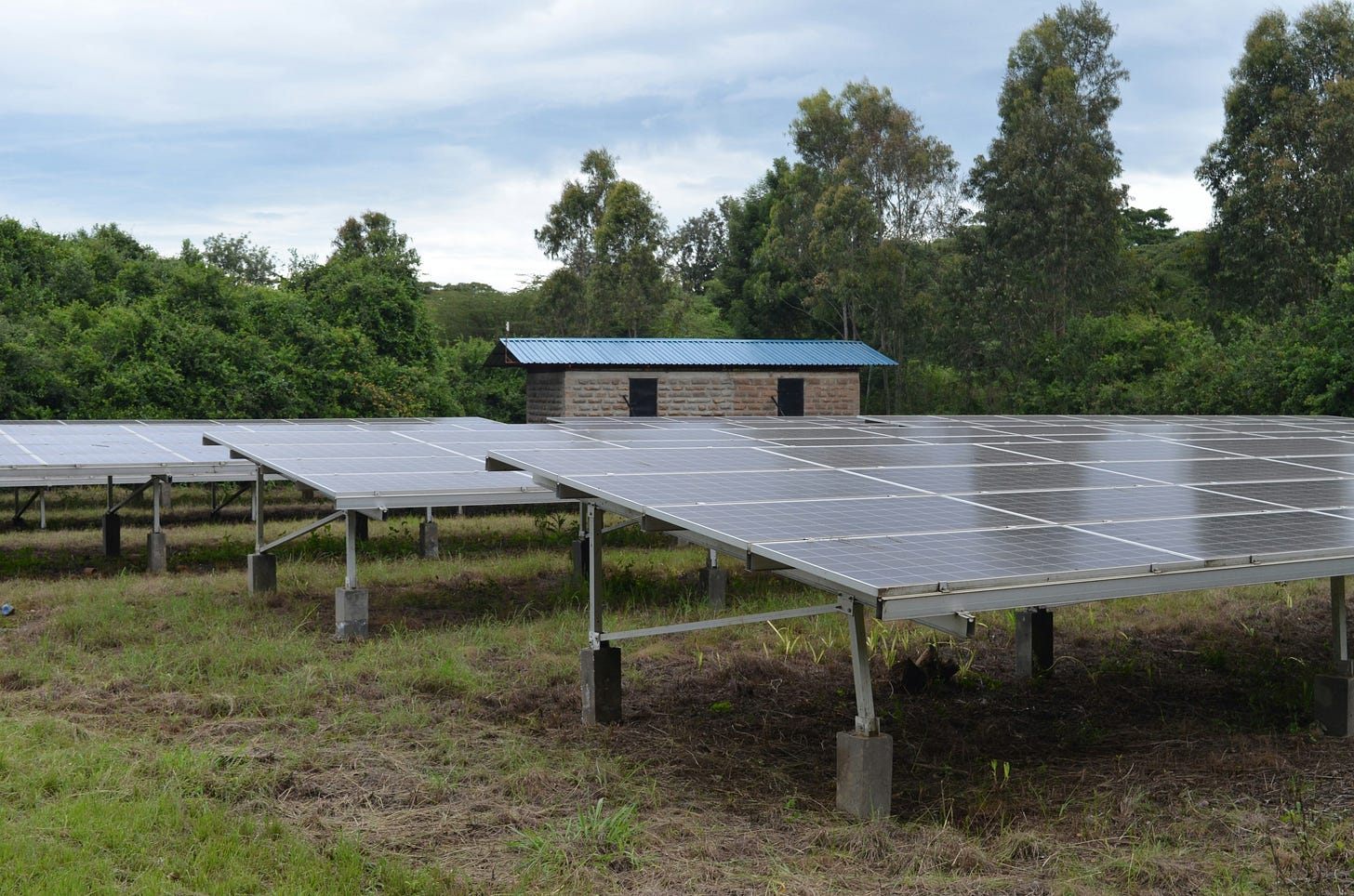
Decentralized Energy Resource (DER) systems, such as mini-grids and household solar systems, are essential for providing power to roughly 500 million Africans without access to modern energy services. For African Governments to meet the Sustainable Energy for All Goal of Universal Access to Energy By 2030, it is estimated that DERs will need to provide at least 40 percent of new power connections. To meet this goal, several changes to mini-grid deployment strategies, policy infrastructure, and financing facilities will be required. This essay explores what is holding back the expansion of the DER sector in Africa and what can be done to accelerate its growth.
TLDR:
- Decentralized approaches to rural electrification have been key to developing power infrastructure everywhere - including across Europe and the United States. Technological innovation has improved the reliability and cost of DERs, making them an ideal technology to address rural electrification.
- Concessional funds have been - and remain - key to rural electrification efforts worldwide. Ensuring that concessional funds are used to promote the least cost option is essential to rural electrification
- Integrated national energy planning is necessary to achieve universal electrification. DERs will not replace national grid infrastructure. Instead, they will provide energy solutions that improve access to create a bidirectional energy network.
- DER developers provide more than power access; they build rural jobs and economies and drive efficiency improvements in service delivery and costs. In conjunction with cost efficiency, demand stimulation is essential to realizing universal access to energy.
- The DER sector needs modern regulatory frameworks built for integrated energy systems. Providing the industry with security and certainty on essential questions around quality standards, tariff regulation, finance access, and grid interconnection procedures is crucial. Templates for these already exist and can be quickly tailored to the needs of countries looking to update their regulations. Standardizing regulatory frameworks across multiple governments is needed to enable scale.
- Results-based Financing (RBF) is needed to ensure public funds are spent in a way that rapidly scales energy access across the continent. Public support for DERs has focused on individual firms and projects and, therefore, has seldom led to scale. Now that pilots have been proven and the sector is beginning to mature, new support mechanisms are needed.
The Energy Challenge in Africa: connecting 600m people to Power while building the Energy System of the Future
The global electricity sector is undergoing one of the most profound shifts in the modern era. Thanks to new technologies such as efficient smart inverters, advanced control systems, the Internet of Things (IoT), and intelligent energy storage systems. We are fast approaching a tipping point at which distributed power generation will be the least costly way to provide electricity to households around the world.
Such a change would mark a significant shift in how energy generation and distribution is currently organized. It also marks a reversion to how power systems first emerged in the early days of the development of the electric grid. In the late 1800s, centrally operated power grids, then known as ‘central stations, ’ were vastly outnumbered by ‘private plants’, the smaller power systems that performed various tasks ranging from lighting the homes of the wealthy to running the streetcars of New York City. (This evolution is chronicled in The Grid by Gretchen Bakke, a great deep dive into how the modern grid came to be and what the future has in store)
Over the course of the 20th century, these private plants gradually gave way to centralized generation. Various regulatory, economic, and technological bottlenecks drove this shift. These made sharing generation capacity across a large base of clients through a monopoly grid operator the most cost-effective and convenient way to provide cities with reliable electricity.
Until recently, this centralized grid paradigm appeared unassailable as a model for power at scale. However, as technological, economic, and regulatory barriers to decentralized generation fall away, attention has again turned to the possibilities a decentralized grid presents. These include lessening the need to construct costly high-voltage transmission lines and increasing the grids’ resilience to natural disasters and cyber-attacks. The exploration of these options is happening globally, from the efforts to rebuild Puerto Rico’s electric grid to private companies across Africa working to connect rural villages to power for the first time.
This push to decentralize the grid does not mean it will become obsolete. Instead, it is bound to transform from a unidirectional network built for a power generator supplying many customers to a ‘Network of Networks.’ This Network of Networks will be characterized by multiple interconnected power generation, storage, and consumption points, allowing smaller grids to be largely self-sufficient while retaining the ability to tap into a broader network to draw additional power or sell excess power.
Why grids will still be important
There are three reasons why this ‘Network of Networks’ vision is the most likely Schelling point for the global ‘grid of the future’:
-
Solar Home Systems (SHS) currently suffer from a ‘double scaling problem’; They are too expensive for productive loads, and storage remains too costly to scale down for productive loads. Demand for power in emerging markets will grow dramatically over the coming decades despite efforts to increase energy efficiency. As populations grow and standards of living rise, power consumption will grow for households and small businesses. While Solar Home Systems offer a powerful entry point for bringing electricity to those without access, they limit how that electricity can be used by requiring specialized appliances that run on DC power and consume significantly less power than commercially available alternatives. Access to grid-style AC power will be crucial to ensuring that these newly electrified users of power do not get locked into using a power system that is incompatible with the power systems of the rest of the world. Providing power that meets the global standard using the off-grid model is prohibitively expensive, with estimates for the capital costs of energy storage alone ranging from USD 3,000 per average Indian household (2.5 kWh/day) to USD 40,000 per average US household (30 kWh/day). Even with the projected reductions in costs over the coming decades, it is most likely that a form of grid electrification will remain the most cost-effective and efficient way to provide productive power across the developing world.
-
Grids are networks; well-managed networks drive resource utilization efficiency, reducing cost without compromising quality. Access to a grid in a world of decentralized power generation, storage, and consumption is analogous to access to a cloud computing service. Cloud computing creates massive scale efficiencies for computing power and data storage by leveraging the internet without eliminating the need for personal computers. Similarly, access to a well-managed energy network would remove the need for complete self-sufficiency while enabling the sale of excess capacity at times of low demand, ensuring optimal resource utilization.
-
The transition to a world primarily run on renewables will require vast storage, and the grid is one of our largest batteries. The need for a robust energy storage infrastructure has become increasingly apparent as the world moves to tackle climate change by deploying increasing amounts of renewable energy from sources like solar and wind. Though several technologies, such as utility-scale lithium-ion batteries, have emerged to fill this gap, they primarily complement the grid rather than substitute it. Building a robust inter-network transmission grid is a powerful way to ensure that excess power produced on a network reaches a suitable consumer or storage point for use at peak load times.
Access to a grid in a world of decentralized power generation, storage, and consumption is analogous to access to a cloud computing service.
Why Private grids are an essential complement to Public grids
Connecting households to electricity for productive use is a capital-intensive exercise, regardless of where it is done. This is made doubly so when the customers being connected are rural due to the high cost of logistics to get to these areas and the high cost of building transmission lines to bring power to rural locations. Comparing these costs to the low incomes of the typical rural energy consumer makes two things clear:
-
A focus on efficiency is essential to achieving the goal of universal and equitable access to energy
-
Reducing the net cost of rural electrification will require utilities to stimulate demand for electricity services
Private sector operators have shown themselves to be best placed to deliver on both these needs. In East Africa, the average unsubsidized cost per connection for private sector mini-grids is less than half of the cost per connection to the national grid. This is driven by an aggressive focus on reducing the cost of capital for mini-grid deployments by sourcing low-cost raw materials and streamlining and standardizing grid development processes. The operations & maintenance costs of private operators are also significantly lower than those of the typical public grid, driven by the use of advanced technologies to remotely monitor, diagnose, and operate grid components such as meters, inverters, and generators. These costs continue to drop yearly as private developers innovate.
These reductions in cost through better processes and technology have been achieved while maintaining levels of reliability and customer satisfaction that are on par with or better than those enjoyed by public grid operators. Private operators continue to lead the way in investing in tools to improve customer engagement and monitor satisfaction, such as SMS-based surveys and alerts. These channels of communication, combined with the ability to monitor customer energy consumption, ensure that operators are aware of customer challenges and can proactively respond to potential issues. The investment in this consumer-centric approach to electricity provision makes private grids an ideal test case for how the future grid will operate and a conduit for integrating advanced technologies into the national grid.
Private sector operators across Africa are also implementing demand stimulation programs that help customers transition from a pre-electrified lifestyle to one that makes the most use of access to electricity. These include appliance financing programs for productive loads, such as motors for sawmills, and household appliances, such as TVs. Operators also provide services such as business training and support to encourage local SMEs to scale up and thus find more uses for electrical power. These and other innovations, pioneered by actors in the SHS space, have redefined the relationship between electricity providers and their customers. They can be adapted to meet customers’ needs on the national grid.
Next week’s post will explore ways in which regulation could help or hinder the growth of DERs across Africa
First published on Substack.