The Case for Proactive Optimism
The question is not whether progress is possible but whether we will choose to be its architects.
I planned to post an article on peer review, research, and AI this week, but I am still refining my thoughts on that topic. Instead, I am posting this essay based on a commencement speech I gave last year to International Students graduating from the University of Texas at Austin. I hope you find it thought-provoking.
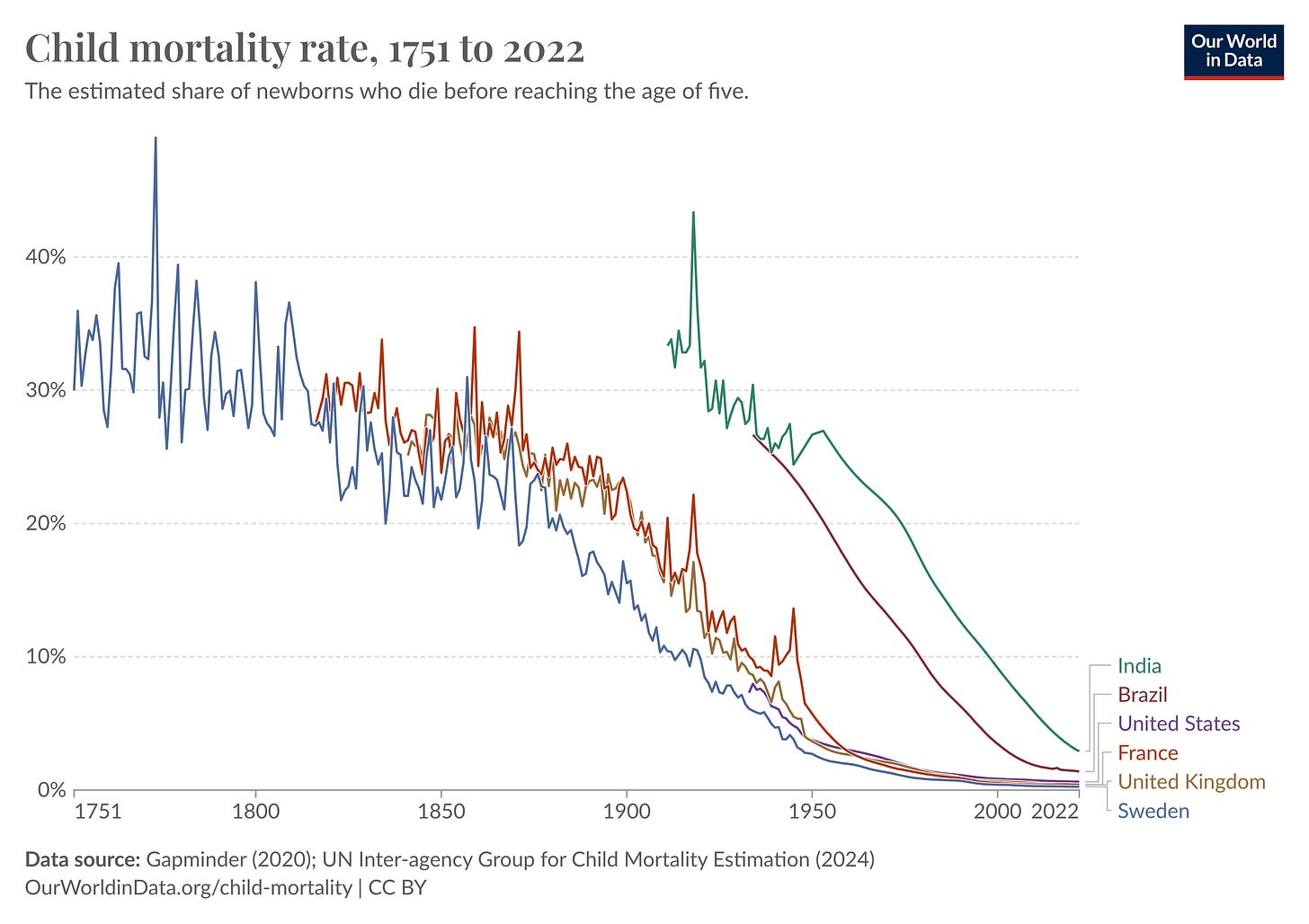
The decline in child mortality over the last 70 years. Source: Our World in Data
In an era dominated by headlines of conflict, climate crisis, and social division, it might seem counterintuitive to suggest that we live in the most promising time in human history. Yet, as I shared with the 2024 graduating class of international students at the University of Texas at Austin, this apparent paradox holds a fundamental truth that could shape how the next generation of leaders approaches global challenges.
The world today presents a complex tapestry of progress and problems. We cannot ignore the devastating conflicts in Ukraine, Gaza, and South Sudan, nor the recent flash floods that claimed hundreds of lives in my home country of Kenya. Having spent six years working on renewable energy initiatives in Africa, I am intimately familiar with the existential threat that climate change poses, particularly to the world’s most vulnerable populations. Our society appears more ideologically polarized and paralyzed by anxiety than ever before.
However, two crucial facts stand in stark contrast to this narrative of decline, both of which are highlighted by Dr. Hannah Richie in her brilliant book “Not the end of the world” : First, more humans are living enriching and fulfilling lives today than at any previous point in history. Second, we possess the unprecedented potential to become the first generation to achieve true sustainability. These assertions are not based on blind optimism but tangible evidence of human progress.
we possess the unprecedented potential to become the first generation to achieve true sustainability
Consider the revolutionary developments in global health: for the first time in history, we have not one but two Malaria vaccines being deployed across Africa. This breakthrough targets a disease that claims over half a million lives annually, with 76% of victims being children under five. The implications of this advancement cannot be overstated: we stand at the threshold of potentially eradicating one of humanity’s most persistent killers.
Environmental progress, while often overlooked, tells a similar story. Global deforestation peaked in the 1980s and has been declining since. Cities like Houston and Los Angeles have witnessed dramatic improvements in air quality, enhancing the health outcomes for millions of residents. Carbon intensity per capita is decreasing as renewable energy technologies reach global inflection points. Even U.S. honey bee populations, once a symbol of environmental decline, have rebounded to record levels.
These improvements didn’t materialize spontaneously. They resulted from deliberate human action. Behind each advancement were individuals who identified problems they cared about, developed expertise in those areas, and worked systematically toward solutions. Their success hinged on a crucial mindset: proactive optimism. Unlike passive optimists who believe progress is inevitable or pessimists who see decline as unavoidable, proactive optimists understand that positive change requires active participation.
Unlike passive optimists who believe progress is inevitable or pessimists who see decline as unavoidable, proactive optimists understand that positive change requires active participation
The path to proactive optimism begins with practical steps. First, we must manage our information diet, distinguishing between staying informed and doom-scrolling through news sites and social media. A focused thirty-minute news review in the morning suffices for most days. Second, we must embrace philosopher Isaiah Berlin’s concept of value pluralism: the understanding that multiple valid values can conflict, necessitating careful trade-offs rather than perfect solutions.
multiple valid values can conflict, necessitating careful trade-offs rather than perfect solutions
This recognition of trade-offs extends beyond values to practical problem-solving. As often emphasized the economist Thomas Sowell, the world doesn’t offer solutions so much as trade-offs, making rapid experimentation crucial. Ideas must be tested on small scales, allowing for iteration and improvement based on real-world feedback. This approach helps overcome our tendency to emphasize an idea’s benefits while overlooking drawbacks.
Perhaps most importantly, we must take the initiative to define the problem. Unlike academic settings where problems come pre-packaged, the real world requires us to identify and frame challenges ourselves. This process often feels lonely, but building something meaningful invariably attracts kindred spirits. My personal experience with the African Leadership Bridge exemplifies this principle. What began as a conversation with my mentor Rick Reeder has evolved into an organization that has funded college education for twenty-three students across the United States and Africa, recently establishing an endowed scholarship at the University of Texas.
As we navigate these challenges, we must remember that everyone, regardless of their apparent expertise or confidence, is experiencing life for the first time. This understanding should embolden us to question established wisdom while remaining open to new perspectives. The future belongs not to those who can perfectly predict it, but to those who actively participate in shaping it through informed, optimistic action.
The world we inhabit is not perfect, nor has it ever been. Yet our capacity to address its imperfections has never been greater. The choice before us is not whether to make a lousy world good but rather how to make a good world better. This responsibility falls to each new generation of leaders with unprecedented knowledge, resources, and technological capabilities. The question is not whether progress is possible but whether we will choose to be its architects.
The promised essay on peer review, research and AI will be out next week
First published on Substack.