With New York's adoption, Congestion Pricing hits the main stage
I became convinced that congestion pricing was the most efficient and effective solution in the urban planning toolkit.
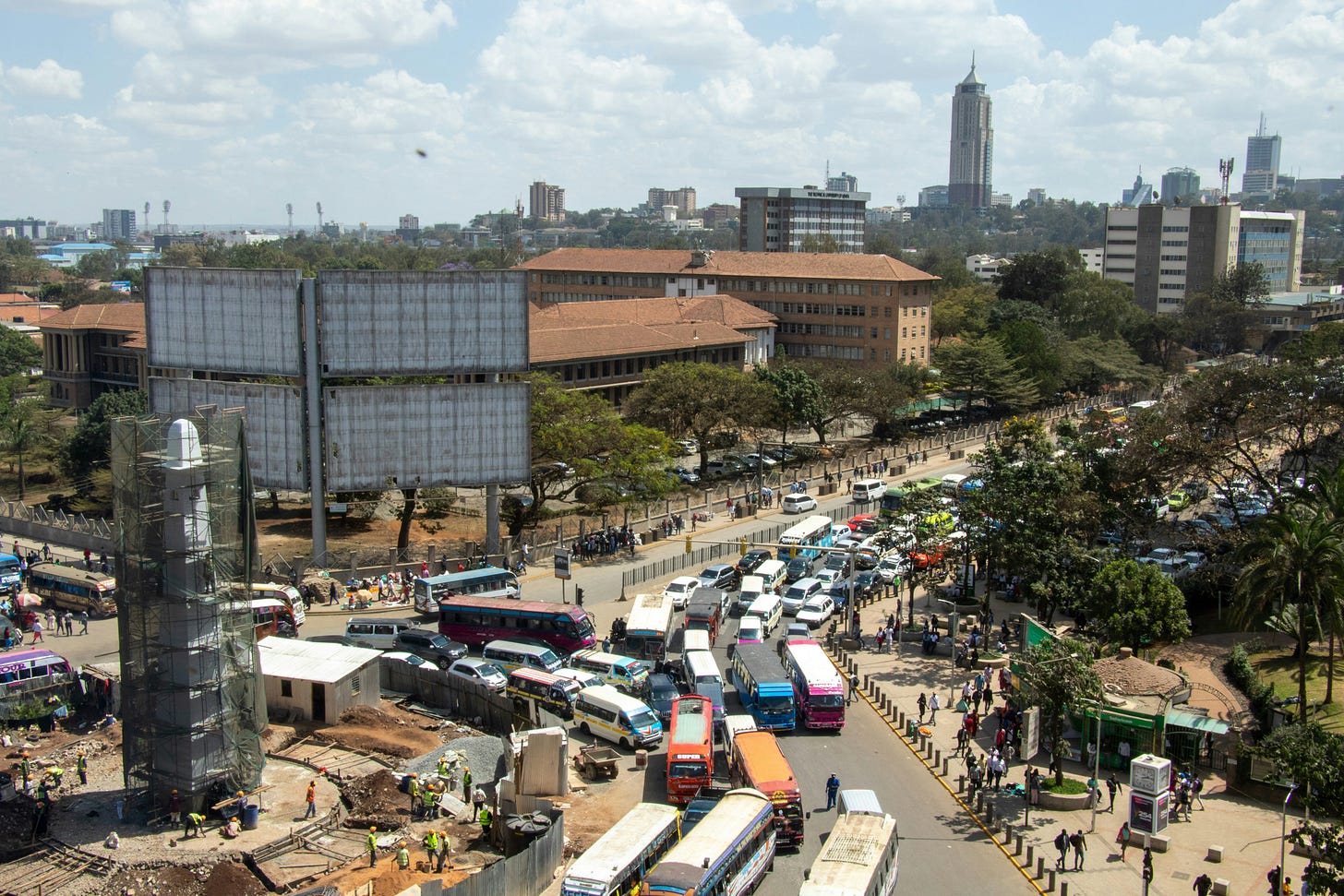
Photo by Michael Njoroge on Unsplash
I have been watching the political negotiation around New York’s proposed congestion pricing scheme. I was quite heartbroken when Governor Hurchel decided to shelve the plan at the last minute. I wrote my 2015 master’s thesis on traffic management in Nairobi, Kenya. I became convinced that congestion pricing was the most efficient and effective solution in the urban planning toolkit. The recent push to approve and implement congestion pricing before the presidential inauguration gives me hope that this underappreciated solution will finally be tested on the most significant urban stage in the world, New York City!
I am publishing a lightly edited version of the thesis here for those interested in understanding how traffic congestion impacts a city like Nairobi and why I think congestion pricing as a solution makes the most sense. It also allows me to celebrate my thesis advisor, Professor Gomez-Ibanez, who has published some of the best research on urban traffic management. I am publishing it in three parts. Part 1 (below) covers the political economy that underpins the traffic situation in Nairobi. Part 2 (to be published next week) will cover Nairobi’s various attempts to solve its traffic problems through new road construction. Finally, part 3 will go over why congestion pricing could succeed where so many other solutions have failed.
Feel free to share your thoughts and questions in the comments.
Summary / TL; TR
Nairobi, the capital city of Kenya, is one of the largest and most dynamic of Africa’s emerging cities. The city is known as the economic hub of the East African region, hosting several major multinationals, multilateral institutions, locally run businesses, and a rapidly growing population of over 4.6 million people. However, Nairobi is also known to have one of the highest levels of commuter pain globally, with traffic congestion estimated to cost the city over $200 million a year. The Nairobi County Government has implemented various measures to curb this growing cost to the city. However, the current and planned set of infrastructure-centric interventions misses the mark on three critical dimensions: (1) they fail to consider the large infrastructure backlog created by the rapid pace of rural-to-urban migration. This backlog points to a pent-up demand for road infrastructure that is unlikely to be satisfied even if the county’s most aggressive construction targets were to be achieved. (2) Current solutions often fail to consider concerns about the equity of access to transportation services. As a result, they are likely to further the trend to prioritize personal mobility options used by more affluent residents of the city at the expense of alternatives that encourage public transit and other forms of transport used by less wealthy residents. (3) The solutions fail to directly address the chief cause of congestion in the city center, i.e., the unsustainably high number of vehicles that require access to key roads in the city center and its immediate suburbs. As a result, the recent burst of new construction in the city is not likely to solve Nairobi’s traffic congestion problem.
I argue that the most effective way to reduce traffic congestion in Nairobi would be to implement a congestion pricing scheme in the city center and surrounding suburbs. The argument derives primarily from an analysis of the county’s congestion problem through the lens provided by the concept of the ‘Fundamental law of road congestion’ (Duranton and Turner 2011). This is illustrated by the experience of major cities such as Singapore and London, which have faced traffic problems similar to those currently being dealt with in Nairobi.
The evidence provided by Duranton and Turner, along with the experience of both Singapore and London, are at odds with the current urban development plan for Nairobi, which does not include a plan for introducing congestion pricing. Instead, the Nairobi Integrated Urban Development Master Plan (NIUPLAN) focuses exclusively on building road and public transportation infrastructure. While such solutions may help address the challenge of inadequate infrastructure, they are not likely to address the city’s most pressing challenge: providing accessible and efficient access to transportation services for its residents. By implementing the plan in its current form, the city risks spending hundreds of millions of dollars on infrastructure that will not only result in little to no reduction in traffic congestion but also serve to marginalize residents without access to personal vehicles further.
Introduction
2008 was the first year in which more people lived in cities than in the rural countryside. Projections show that urbanization combined with the overall growth of the world’s population could add another 2.5 billion people to urban populations by 2050, with close to 90 percent of the increase concentrated in Asia and Africa. These data point to a transition in human habitation patterns and highlight the increasing importance of urban spaces as centers of human life. It is estimated that by the year 2050, about 66% of all humans will live in urban areas. Africa sits at the forefront of this wave of rural-to-urban migration, and it’s 1 billion people are now more urban than India’s billion (40% versus 32%). Perhaps more telling is that Africa now boasts more cities of more than 1 million people than Europe.
One of the largest and most dynamic of these emerging African cities is Nairobi, the capital city of Kenya. The city is known as the economic hub of the East African region, hosting several significant multinationals, multilateral institutions, locally run businesses, and a rapidly growing population of over 4.6 million people. It also has the dubious distinction of being among the highest scorers on the IBM Research Institute measure of urban commuter pain. This high level of commuter pain does not simply reflect the inconvenience residents experience while stuck in traffic; It translates into very real economic and health costs. A recent study shows that the city of Nairobi loses about $570,000 a day to traffic congestion. In addition, there are attendant healthcare costs that the city needs to contend with. Over 13,000 people die as a result of road accidents every year in Kenya (26 per 100,000 as compared to a 10 per 100,000 annual traffic mortality rate in the US).
One of the distinguishing aspects of Nairobi’s transport landscape is its lack of a well-developed and effective urban transportation system. “Public transportation” in Nairobi is primarily privately provided through a loose network of approximately 20,000 minibusses (Matatus) notorious for their reckless driving, pollution, and poor service. Despite these shortcomings, they fill an essential gap in the city’s urban transportation infrastructure, as publicly funded alternatives are inadequate. The national government and the municipal authority of Nairobi have attempted to improve the availability of publicly financed alternatives to the ubiquitous matatu with little success owing to various factors, including a lack of political will, financing, and technical capacity. With the promulgation of Kenya’s 2010 constitution, which enshrined the principle of devolution of power through county governments, there are renewed efforts to find national and county-level solutions to the problem of urban congestion and transportation in Nairobi. The solutions proposed under the current Nairobi Integrated Urban Development Master Plan are partly an outgrowth of the renewed interest in addressing this issue. These solutions currently cluster around two approaches to addressing the city traffic problem:
- Building additional roads, upgrading urban road transportation infrastructure, and
- Developing mass rapid transit Systems
Both of these approaches, though necessary, do not take a sufficiently systemic view of Nairobi’s challenges with traffic congestion and thus fail to address two critical aspects of the problem of persistent traffic congestion in the city: (1) the rapid and accelerating rate of vehicle acquisition by Nairobi residents, and (2) the impact of the high and rising level of pent up demand for road and transport infrastructure, on how quickly residents will feel the impact of new infrastructure. As a result, the city’s construction efforts are likely to create a phenomenon known as ‘induced demand’, where increased infrastructure development serves to accelerate rather than decelerate the primary driver of traffic congestion (the number of cars on the road). Such an outcome would, at best, maintain the status quo with regard to congestion in the city and, at worst, could make congestion worse, eroding political support for further construction efforts as residents fail to see the immediate results from existing infrastructure investment.
Nairobi’s current transportation landscape
The role of Matatus
It is impossible to think about urban transportation in Nairobi without thinking about the role of Matatus. Matatus are estimated to provide about 85% of the ‘public’ transportation in the city. This not only makes them indispensable in the transportation landscape of the city but also makes them a formidable political force. Matatu owners, represented by the Matatu Owners Association (MOA), wield significant power over transport policy and often conflict with the city and the national government. Recent conflicts at the national level have included a battle with the Ministry of Transport over the requirement that all Matatus be fitted with seat belts and speed governors that limit the cars to a top speed of 80 KM per hour. These were hard-fought and involved multiple instances of mass action by the Matatu owners, almost bringing the city to a standstill.
Contrary to what one might expect, when Matatus go on strike in Nairobi, effectively removing 20,000 minivans from the city’s roads, traffic jams increase, more than tripling the time it takes to get across the city in some instances. This is because many car owners who ordinarily leave their cars at home and take a Matatu are forced to drive to and from work. Given that on an average day, traffic congestion results in a productivity loss of over half a million dollars, these Matatu strikes can inflict millions of dollars of damage on the economy in a single day. Matatu strikes are, therefore, very effective in getting policymakers to enact legislation favorable to Matatu owners.
The 2011 Matatu ban
Analyzing the fate of the 2011 Matatu ban provides insight into the political supportability of public transport policy that the MOA views as threatening to its survival. The administration of former president Mwai Kibaki decided to ban the importation of Matatus after 2011. Understandably, this ban was interpreted by most in the Matatu industry as an existential threat. The MOA argued that the capital requirements for purchasing the larger buses that the government was pivoting towards were too high and would lock the majority of operators out of the market. High bank interest rates made borrowing to finance the transition prohibitively expensive, and the MOA questioned the economic viability of running the large buses on short city routes. Larger buses would be harder to fill on every trip and yet would cost more to fuel per trip.
The government, for its part, saw the transition to larger 51 and 73-seater buses as a necessary step to take if Nairobi was to have any chance at taming its crippling traffic jams. The city was losing millions of dollars due to the clogged city streets, and the city infrastructure was crumbling under the weight of the ever-expanding number of cars on the road. After years of stagnation, the Kenyan economy started picking up in 2002. The election marked the country’s first democratic transfer of power and would prove to be a watershed moment for the country’s economy. The subsequent expansion of the middle class contributed to a massive increase in the number of cars imported into the country. By the mid-2000s, it had become clear that the government would need to find ways to reduce the number of cars on the road in addition to pursuing a road expansion strategy. The 2011 ban on further Matatu imports emerged as part of this larger traffic reduction project. Siding with the government on this new legislation were the Savings and Credit Cooperative Organizations (Saccos) and other franchise owners of the larger high-capacity buses such as 2NK, Muga, Kenya Bus Services (KBS), Molo Line, and Eldoret Express.
This new crackdown on Matatus was met with resistance from Matatu owners. After months of negotiation, the MOA declared a 3-day strike in the city and scheduled it for the first week of January 2010. As the date loomed closer, frantic attempts were made by politicians and other government officials to try and reach a compromise, but to no avail. On the morning of the first day, thousands of workers could be seen streaming out of low-income Neighborhoods across the city as they set off for work, a journey that for some took several hours on foot. Counter-intuitively, the already congested city roads ground to a complete standstill, as any individual with a car was forced to drive because of a lack of alternatives.
The effects of the ban
Despite this dramatic show of force, President Kibaki’s government stayed the course. In January of 2011, the ban went into effect as planned. The new regulation had several knock-on effects. Matatus imported into the country dropped from 3,564 in 2010 to 253 in 2011. Conversely, the number of buses registered went up by 30 percent from 1,286 in 2011 to 1,680. The increase in bus registrations was popular with manufacturers and a segment of the public because, unlike Matatus, most buses were imported as completely knocked-down kits and assembled locally, providing manufacturing jobs. In addition, the cost of maintaining matatus started to increase due to a lack of spare parts. Spare part importers had become reluctant to serve what was now doomed to be an ever-shrinking market. Mr. Dickson Mbugua, Chair of a Matatu lobby group known as The Matatu Welfare Association (MWA), noted that about 25% of the Matatus that were previously on the road had been pulled off due to the owner’s inability to operate them profitably. As a result of these challenges, the larger bus owners, with the help of the government, were well on their way to taking back the market for public transit in Nairobi by the end of 2012.
The reversal
As Kenya entered the year 2013, the country was in flux. It was an election year in which the country would, for the first time, be voting-in officials in a new, more decentralized, county-based government. This was due to the promulgation of a new constitution in 2011. One of the key constituencies in the leadership race was the large and powerful group of individuals involved in the transportation sector.
Vigorous lobbying of the new government by the MOA eventually won matatu owners a concession. In August 2013, the new president, Uhuru Kenyatta, ordered a loosening of the restrictions on Matatu importation and registration to enable the industry to serve the outskirts of the city. The MOA argued that in addition to killing an industry that was providing a large number of jobs to the youth (a stated priority for the new government), the ban was forcing existing operators to compete with unregistered taxis that were using even lower capacity vehicles to fill the need for transportation by illegally ferrying passengers in the periphery of the city. Emboldened by this victory, the Matatu operators redoubled their effort and started to claw back some of the market share they had lost to larger operators. The larger operators, for their part, saw their political influence erode as the national government moved towards the MOA and the MWA.
The failure of the attempt to ban matatus illustrates the difficulty of finding a politically supportable path to reducing the number of vehicles on the road. This could partly explain the subsequent shift to a transportation policy that focuses almost exclusively on constructing and acquiring additional transportation infrastructure. This new approach is outlined in Nairobi’s Integrated Urban Development Master Plan (NIUPLAN).
The Nairobi Integrated Urban Development Master Plan
The NIUPLAN is the fourth master plan that the city has had since 1927 and is designed to cover the period from 2014 – 2030. A new master plan was necessary because the previous plan, put in place in 1973, was designed for a city of 800,000 people. Since then, the city’s population has more than quadrupled to approximately 4.6 million, due mainly to rural-urban migration. The Government of Kenya formulated the NIUPLAN with significant technical assistance from Japan through the Japan International Cooperation Agency (JICA). The plan highlights the severe problems that have resulted from decades of unplanned growth in the city’s perennial traffic congestion. Both the World Bank and the Chinese government have pledged nearly half a billion dollars for urban transportation infrastructure in Nairobi, partly informed by the recommendations in the NIUPLAN. This money has been earmarked for two types of projects:
- Building new roads and upgrading current road infrastructure along with related improvements to non-motorized transit infrastructure
- Selecting and implementing Mass Rapid Transit Solutions for the nine major corridors into Nairobi’s Central Business District (CBD)
Next week’s post will further explore both approaches and discuss why they are helpful but insufficient approaches to solving traffic congestion.
First published on Substack.