Power to the People (part 3): On Financing DERs in Africa
Advocating for an approach in Africa which ultimately puts the full burden of cost on the poorest, most vulnerable rural people would be both regressive and historically unique.
This is part three of an essay adapted from a position paper I wrote in 2018 as a director at the Africa Mini-grid Developers Association (AMDA). I’ve included part one here and part two here. It has been edited for clarity and to account for developments over the past six years.
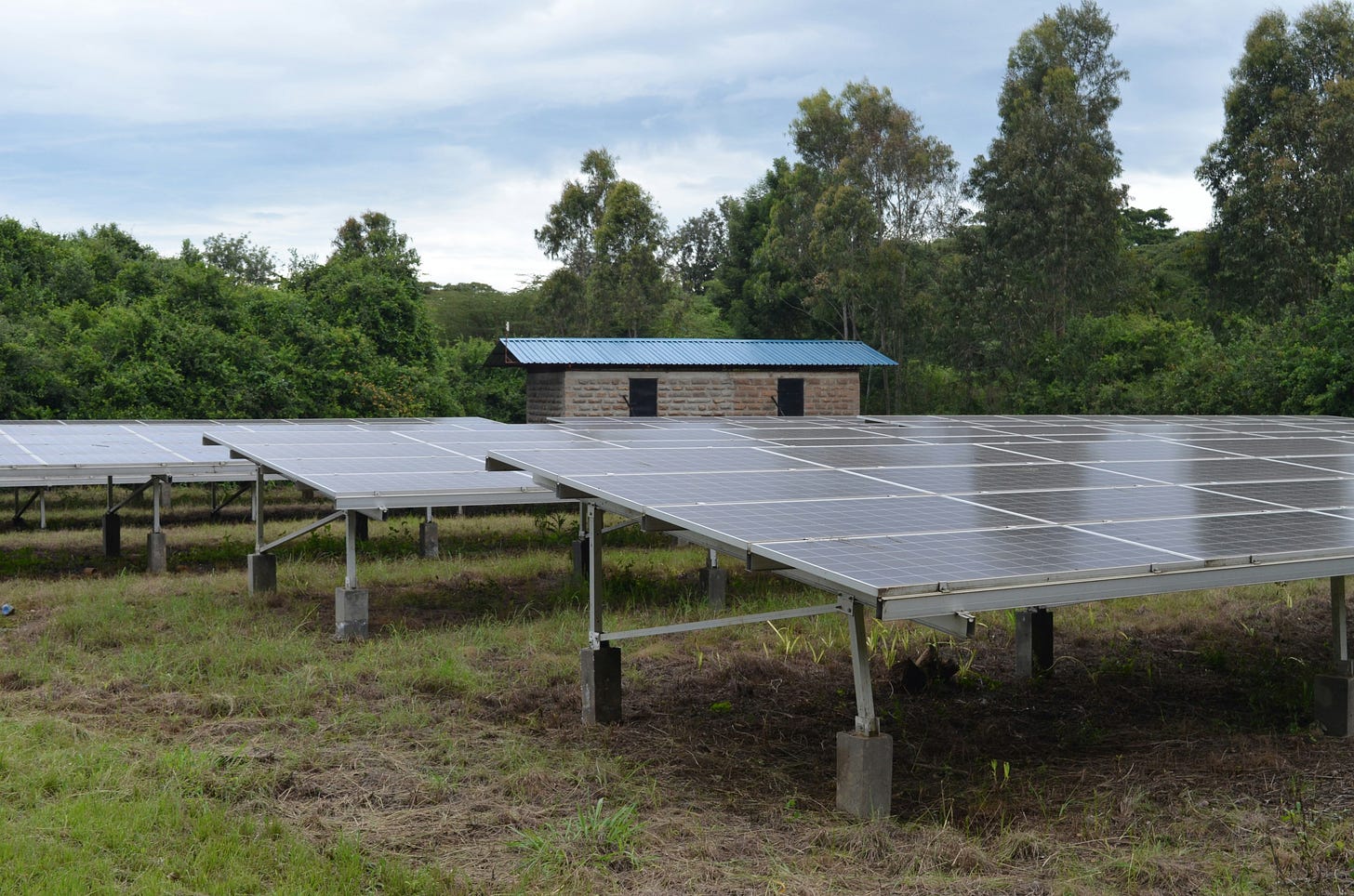
Photo by david ouma on Unsplash
How grids are financed: the historical precedent of subsidies in rural energy access
Whether one looks at the United States in the 1930s, China in more recent decades, or any other country that has electrified its rural population over the past century, one finds a key commonality: all have used public sector funds to subsidize energy access for their rural populations.
No country in the world has achieved rural electrification without substantial concessional money. Utilizing wealth surpluses from urban areas to enable equality of energy access for less affluent rural areas is a well recognized, progressive approach to expanding access. Advocating for an approach in Africa which ultimately puts the full burden of cost on the poorest, most vulnerable rural people would be both regressive and historically unique.
Advocating for an approach in Africa which ultimately puts the full burden of cost on the poorest, most vulnerable rural people would be both regressive and historically unique.
While some point to the reducing cost of solar and batteries, and improving appliance efficiency as evidence of a changing paradigm, analysis of current and future power needs in the developing world does not support such claims. “Subsistence energy” may be possible through autonomous, households-scale small systems (at a very high price per kilowatt-hour), but in order to power productive loads and grow rural economies we will still need substantial investment in rural energy systems and grids. Autonomous solar home systems are excellent at solving lighting and low-level energy needs, but they will not provide the power needed for rural communities to develop, nor enable long-term energy equality between rural Africans and other global consumers.
There is little doubt that we still live in a world where concessional money is critical to enabling growth in the renewable energy and energy access sectors. The United States solar industry depends on the Investment Tax Credit, while many European countries also support the propagation of solar through subsidized feed-in tariffs. Despite the acceptance of the need for public sector support for renewables in developed countries however, many investors come to Africa demanding “commercial projects” in energy access, forgetting that the projects that they fund in the US and Europe are enabled by a system of non-commercial support from the public sector, and an electricity distribution system which has had a century to depreciate. For energy access and renewables to succeed in Africa, we must be wary of this double standard.
The increasing availability of subsidized funding for public sector grid extension in several countries indicates a positive trend towards recognizing the importance of this type of funding for rural electrification. Unfortunately however, current funding mechanisms are contributing to a highly uneven playing field between the private and public sector actors. This has resulted in a mismatch between funding availability and the most effective approaches to improving access to power. There are essentially two categories of subsidy for energy access in Africa:
-
For the private sector: donor grant programs for private projects. These grants are typically small (significantly less than USD 50M for a full country), and very onerous for companies and projects to utilize (require extensive dew diligence before approval participation, are prohibitively expensive to comply with, and take unreasonably long to disburse funding even after approval).
-
For the public sector: extremely low interest loans to governments from donor-lenders, which are passed to public utilities as pure grant or extremely low-cost debt. These concessional loans are typically large (> USD 500M) and low-friction for the public utility to draw down on.
`
The concessional funding available to the private sector is useful for piloting, but not suitable for scale. The public sector has access to orders of magnitude more funding through structures which are much better suited for scale. If we hope to have a vibrant private sector in energy access in Africa, this asymmetry must be addressed.
How financing should be configured to enable Private Utilities
There are several things that grant programs aiming to catalyze the private sector can do to make their funding more usable. These changes are essential to the success of the sector as it is becoming increasingly clear that significant portions of allocated funding is not currently reaching projects on the ground. For example, in Tanzania and Kenya, tens of millions of dollars have been available on paper for the past 3 years to support private companies developing micro-utilities, but only a tiny fraction of that amount has actually been disbursed to projects.
S.M.A.R.T Results Based financing
The first step in addressing this funding bottleneck should be to learn from the successful subsidy programs used for solar in the United States and Europe. Simple results-based financing (RBF) was key to the success of these programs and should form a core part of any approach to providing subsidies for private utilities in Africa. Put simply, if a company develops a project that connects customers to power, funders should provide a fixed rebate per connection installed to relieve the capital cost burden of the project so it can attract commercial capital.
Though there are several RBF programs currently running which target the DER sector, most are hampered by excessively complex evaluation and approval processes. This has resulted in a large discrepancy between the amount of RBF funding pledged to the sector and the amount that has been deployed. To achieve their full potential, current and future RBF should strive to conform to the criteria for ‘SMART RBFs’ outlined by AMDA. This criteria seeks to promote RBF programs that are Simple, Measurable, Africa-wide, Repeatable, and Timely. The criteria is discussed further in the AMDA white paper on SMART RBFs.
Once funders structure their programs to enable the private sector to make full use of them, then the private sector will start to gain enough scale to catalyze the second change which is necessary for the private sector to have a place in energy access in Africa: private-public subsidy parity institutionalized at the country government level.
Through demonstrating capital efficiency, innovation, scale, and customer service, the private sector must show large scale lenders and the local governments they serve that subsidy parity between the public and private sector is wise policy. When the lenders make a USD 1B loan to a country, the country and the World Bank must see the potency of configuring that funding to support not just the national utility, but a diverse landscape of private developers and operators as well. Only when this country-level institutionalized support has been achieved will the private sector truly have a role to play in the long-term energy access story in Africa.
Concessional project debt
The second major component of an effective funding structure for DER developers is project level debt. This debt needs to either be offered on concessional terms or blended with other grant and concessional funding in order to be a viable option.
A major bottleneck to the availability of such funding appears to be the low number of deployed assets currently in the market with many funders requiring an installed asset based of USD 10M or more to consider a developer for investment. This creates a chicken-and-egg situation for a growing sector characterised by several small players looking to scale. In order to address this challenge, sector enablers should work toward more effective aggregation mechanisms for existing developers. Such aggregation could include new approaches to channelling lending at the sector level such as portfolio aggregation.
What various players can do to enable this future
Achieving the vision of an electrified African continent that models what the grid of the future should look like will require concerted effort from, and coordination between, key players in the electrification sector including governments, funders and DER developers. Though progress has been made by each of these stakeholders over the past few years, more will be needed over coming decades to ensure that the private DER sector achieves its potential as a key tool for meeting the continents universal electrification targets.
Funders should push for subsidy parity between public and private utilities to take advantage of the private sectors lower customer connection cost and encourage the development of smarter grid infrastructure
Each of these stakeholders has an important role to play in making this potential future a reality:
- Governments should streamline and harmonize national policies governing DERs to provide clarity on key issues such as national electrification strategies, grid interconnection standards, and the allocation of national electrification funds to DERs through transparent results based financing programs.
- Regulators across the continent should strive to align national policies based on emerging best practices to lower barriers to entry for DER developers. This would help create regions with large enough addressable markets to attract the scale of funding necessary to achieve the continents ambitious electrification targets
- Funders should aim to increase the proportion of financing that gets deployed to developers in addition to increasing overall funding allocation. This can be achieved by committing to clear standards for effective financing programs such as SMART RBFs and increasing the levels of coordination between providers of grant, debt and equity funding to the sector. Funders should push for subsidy parity between public and private utilities to take advantage of the private sectors lower customer connection cost and encourage the development of smarter grid infrastructure. Concessional funders will also be instrumental in supporting innovation in the DER sector by providing funding for experimentation with new business models and technologies.
- Developers should seek to bring clarity to the DER sector with regards to minimum quality standards, funding needs, project pipelines, connection rates, grid economics and customer satisfaction. This will require robust organizational structures such as AMDA which can act as a conduit for both policy advocacy and information sharing. Developers should seek to build cross-national partnerships to accelerate learning in the sector and attract scaling capital. Additionally, the private sector must show large scale funders that subsidy parity between public and private sector is wise policy. This can be accomplished by demonstrating capital efficiency, innovation, scale, and excellent customer service.
This is the last post in this series. Next week I will be sharing some thoughts on AI, the apparent slow down in research productivity and the research replication crisis. Merry Christmas and Happy New Year!
First published on Substack.